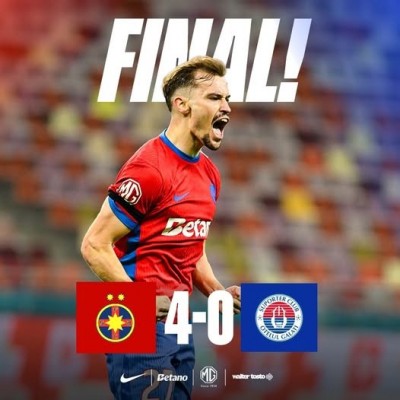
In the heart of the Romanian capital, where politics intertwines with sport, and religion intersects with investment, FCSB stands as a mirror reflecting the transformations of an entire society. A club that was once a symbol of footballing dominance in Eastern Europe now finds itself in a state of sharp decline—not only in results, but in its psychological and symbolic foundations.
Gigi Becali: From Leader to Shadow
It is impossible to speak about FCSB without addressing the figure of Gigi Becali, a man who went beyond wealth and management to become a cultural phenomenon. Becali was not merely an owner; he was a “popular charisma,” speaking on behalf of the fans, attacking coaches live on television, and praying publicly for victories. Yet he was also responsible for creating an unstable environment, where decisions shifted with moods and football was run by market logic rather than long-term vision.
Becali’s retreat from the spotlight was not the end of his influence, but the beginning of a vacuum. The club lost the “loud identity” that once defined it and failed to construct an institutional alternative capable of leading the next phase.
Technical Decline: Between the Absence of a Project and Eroding Ambition
In the 2025/26 season, FCSB sits in eleventh place, with a negative goal difference and inconsistent results against teams that were once considered inferior. This is not merely a statistical decline, but a collapse in the team’s tactical and mental structure.
-
No clear footballing project
-
Rapid turnover of coaches
-
Administrative instability
-
Players losing confidence and identity
All of this has turned the club into a “big name without a soul,” participating in the league out of historical obligation rather than as a fierce contender.
The Fans: From Dream to Confusion
FCSB supporters, once known for filling the stands with songs and banners, now live in a state of emotional detachment. They no longer see the team as an extension of their dreams, but as a psychological burden. This disconnect between club and supporters is the most dangerous challenge any sporting institution can face, as it signals the loss of popular legitimacy.
Is There Hope?
Perhaps the solution lies in a return to the roots: building a long-term project, separating management from personal moods, redefining identity, and acknowledging that modern football is not run through statements, but through methodology.
FCSB does not need a superhero, but a collective mind—one capable of placing the club on a new path and restoring its status, not merely as a team, but as a cultural and sporting symbol.