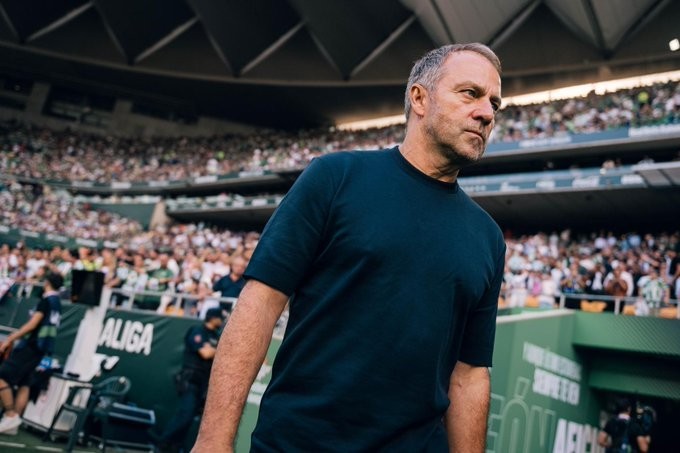
Hansi Flick Crowns Lamine Yamal Before Paris: A Coach’s Testimony or an Election Campaign?
Between a stunning goal in Seville and the Ballon d’Or ceremony just days away, the German coach says out loud what many have been whispering: the 19-year-old is no longer a star in the making. He has become the benchmark itself.
Dr. Talal Othman, General Manager — GCC Sport
Not every sentence spoken at a press conference carries the same weight. Some are forgotten before the ink on the story dries; others are written to last. When Hansi Flick stood before reporters on Saturday evening after Barcelona’s win over Real Betis, he was not merely commenting on a match. He was putting his signature on a historic verdict: Lamine Yamal is currently the best player in the world.
The sentence is short, but it carries enough charge to ignite a debate that will not settle before October 26.
A Goal That Writes the Verdict
The verdict did not come from nowhere. Flick’s statement followed Yamal’s outstanding display in the 5-2 win over Betis, a victory that preserved Barcelona’s perfect start in LaLiga and their place at the top of the table. Yamal opened the scoring with one of those goals people rewatch not to understand how it went in, but to confirm it actually happened. Flick made no effort to hide his amazement, calling the goal incredible and declaring its scorer the best in the world right now.
For those who want numbers before poetry, they are there too: eight goals and nine assists in ten matches this season. These are not the numbers of a gifted winger. They are the numbers of a player who builds half his team’s identity with his feet.
From “If He Isn’t Already” to “Right Now”
What stands out in this story is not the praise itself, but how its wording has evolved. Just one week earlier, Flick was more cautious, saying Yamal would be the best player in the world if he wasn’t already. The difference between the two sentences is not linguistic; it is political through and through. In the first, the coach left the door ajar. In the second, he shut it and announced the result.
Anyone who knows Flick understands he is not a man given to exaggeration. He is a cool-headed German coach who measures his words the way he measures the distances between his lines. When he abandons his restraint, it means one of two things: either he is completely convinced, or he has decided the time has come to stand publicly in his player’s corner.
Timing Does Not Lie
Let us be frank. This statement cannot be separated from the Paris calendar. The Ballon d’Or will be awarded on October 26, and Yamal arrives at the ceremony as one of the leading contenders. Days earlier, the player himself opened the battle, saying that he and Mbappé were the two best players in the world and that his teams’ success should place him first.
At the time, Flick did not hide a mild discomfort, saying he would have preferred the player not to talk about it, while accepting it as part of his self-belief. Today, the coach no longer distances himself from his player’s words. He repeats them in his own voice. That shift deserves attention: Barcelona are no longer defending Yamal. They are leading his campaign.
The Memory of Exclusion
This Catalan insistence cannot be read without recalling last autumn’s wound. Yamal finished second behind Ousmane Dembélé in the Ballon d’Or and had to settle for the Kopa Trophy as the best player under 21. Back then, Flick spoke in the tone of a man swallowing defeat: it was a decision that could not be changed, but Lamine would have another chance next year.
That “next year” is now. And between the two seasons, the young man has added to his cabinet what makes the case for overlooking him far harder to sustain: he won the World Cup with Spain and LaLiga with Barcelona last season. The question is no longer whether he deserves it, but by what logic he could possibly be passed over.
The Other Face of Genius
Analytical fairness, however, demands looking beyond the celebration. In the very match in which Flick crowned him king, he chose to take him off, sidestepping questions about Betis’s protests and simply explaining a substitution that angered the home crowd. Therein lies the deeper paradox: the best player in the world is withdrawn from the pitch because the context requires it.
This is not a contradiction; it is the essence of the project. Flick understands that Yamal’s genius does not mean he must carry the team on his shoulders every week. He noted that his player has featured in almost every match, yet remains fully focused and committed. The reference to workload is no accident. Barcelona know that the greatest threat to Yamal is not defenders, but the fixture list.
Conclusion: A Premature Verdict or a Belated Admission?
Flick’s critics may argue that a coach lacks the neutrality needed to issue such a verdict, and that every manager sees his own player as the best. In theory, that is true. But the difference this time is that Flick is not alone. Opponents have started saying it too, as Real Sociedad’s coach did when he stated that Yamal had shown once again that he is most likely the best in the world.
When the opponent agrees with the coach, praise becomes testimony, and testimony becomes a verdict. On October 26, voters in Paris will not be asked whether Lamine Yamal is talented. They will be asked whether they are ready to admit that an entire generation has passed from one pair of hands to another.
Flick has had his say. The ball is now in Paris’s court.