Liverpool Without Answers at Anfield: When Heavy Spending Becomes a Psychological Burden
Another goalless draw exposes a "legacy crisis" colliding with present-day realities under Iraola
Anfield, the fortress that was once nearly impossible to storm, is turning this season into the stage for an identity crisis Liverpool has not faced in fifteen years. The scoreless draw Fulham forced on the Reds in Matchday 4 of the Premier League was not just another result to file away in a long season it was an unambiguous statement that Andoni Iraola's rebuilding project remains far from mature, despite the tens of millions of pounds poured into his summer signings.
Numbers That Condemn, Not Acquit
Liverpool did not lack for effort: the hosts fired fourteen shots to their visitors' ten and came out ahead on expected goals (1.13 to 0.71), yet the gap between the statistics and the result on the pitch sums up the team's entire predicament — a rattled final third, and attacking decisions that grew "increasingly desperate and haphazard" as the clock wound down, as match reports described it. Victor Munoz struck the crossbar early on, Josh King forced a save out of Alisson, and Rodrigo Muniz and Alexander Isak both squandered late chances that could have broken the deadlock. The result: a draw that rewarded no one, but condemned Liverpool more, because the gap in expected output was supposed to translate into a win.
A Record Unmatched Since 2011
The statistic that speaks most clearly to the depth of the crisis is this: for the first time in sixty-three seasons, Liverpool failed to win either of their opening two home league matches in a single campaign. Four consecutive league draws at Anfield have not happened since November 2011 — a number that recalls the club's darkest spell of the last decade, and puts Iraola in front of a direct question: does he actually possess the tactical answers to break down a low block, or was his success at Bournemouth a product of an entirely different context?
An Absence Beyond the Pitch: Life After Salah
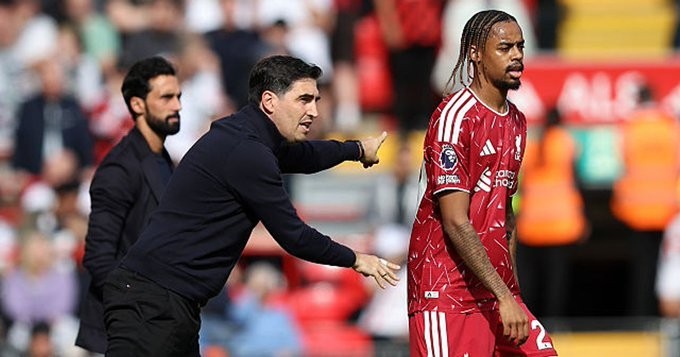
Liverpool's attacking crisis cannot be read in isolation from the bigger picture: this is the club's first season in eight years without Mohamed Salah, who left this summer on a free transfer to Turkey's Trabzonspor, closing out an entire era of decisiveness and attacking output. The club tried to fill that void with expensive recruitment Bradley Barcola for £123m from Paris Saint-Germain, Victor Munoz from Osasuna, alongside defensive reinforcements in Jeremy Jacquet and a loan deal for Ronald Araujo from Barcelona a total outlay north of £242.5m. But money alone does not buy cohesion. Barcola, making his first Premier League start, has yet to find the chemistry that turns individual talent into collective effectiveness, which explains why Liverpool's attack, for all its possession and effort, looked toothless at the decisive moment.
Iraola's Admission: Fatigue Is an Excuse With a Short Shelf Life
After the match, the Spanish coach made no attempt to dress up the picture. He said plainly: "Clearly we lacked some freshness, no? We didn't have the moments to create the differences," adding that "everything has cost us a lot today." There is a measure of realism in those words, particularly given the team was playing its third match in a single week following the Champions League trip to face Atletico Madrid but they also expose the fragility of load management at a club that is supposed to boast one of the deepest benches on the continent. When a manager admits that "this is going to be the season" and that his team "has to find ways to win these games where we play less than 72 hours apart," he is setting himself up for a test that is administrative as much as it is tactical.
Fulham: A Point That Rescues a Project, Not One That Halts It
For their part, the draw was a morale-boosting achievement for Alvaro Arbeloa, who picked up his first point as Fulham manager after three straight defeats. His side showed notable defensive discipline and the composure to manage transitions without getting exposed on Liverpool's counters exactly what Arbeloa was after when he said his team had "realised how important it is to be balanced" against fast English sides. There is a striking irony in the newly arrived manager drawing a clearer tactical lesson than his counterpart in charge of one of Europe's biggest clubs.
The Final Word
Liverpool currently sit sixth with six points from four matches, four points adrift of leaders Manchester City and Arsenal a standing that reflects less the scale of the summer spending and more a genuine crisis of adaptation. The problem now goes beyond bad luck or passing fatigue; it is about the team's identity in the post-Salah era, and about whether Iraola can turn a massive financial investment into a coherent playing system before this stuttering start hardens into a real crisis of confidence. The next two fixtures, against Tottenham and Bournemouth, will be a genuine litmus test: either Anfield reclaims its old authority, or these repeated draws turn into an unsettling question about the very worth of the "revolution" the Spanish coach has led since taking charge.
Dr. Talal Othman, General Manager — GCC Sport