Mexico 1970 World Cup: Pelé Leads Brazil to the Greatest Triumph in Football History
With humanity landing on the moon and satellite technology spreading across the globe, the 1970 World Cup in Mexico became the first edition ever broadcast in color, marking a new era in global sports. It also delivered unforgettable moments—none greater than Pelé’s Brazil, who carved their name in gold and claimed the Jules Rimet Trophy forever after what many still call “the greatest team in football history.”
Two years after hosting the Olympics, Mexico welcomed the ninth World Cup, played at altitudes ranging from 1,800 to 2,600 meters, under intense midday heat and thin air. Yet critics unanimously hailed it as one of the most beautiful tournaments ever staged. The semifinal between Italy and West Germany (4–3 after extra time) is still considered one of the greatest matches in World Cup history.
Technological progress shaped the tournament as well:
-
Substitutions were allowed for the first time.
-
Yellow and red cards were officially introduced (though no player was sent off).
-
It was the first World Cup held outside Europe and South America.
Brazil’s Tournament of Glory
Brazil had skipped the 1967 Copa América but dazzled in the qualifiers with new stars like Gérson, Jairzinho, and Rivellino. Pelé described the squad as “the best team in history,” led by Mário Zagallo, the first man ever to win the World Cup as both a player and a coach.
Pelé’s third world title remains a masterpiece in the legacy of “The King,” who dominated the tournament with brilliance fueled by a desire to avenge the disappointment of 1966. After suffering injuries and harsh treatment in England 1966, Pelé vowed never to play in the World Cup again and stayed away from the yellow shirt for two years.
But when Zagallo—his teammate in 1958 and 1962—took over the national team, Pelé’s belief returned. He regained peak fitness and, at age 29, delivered one of the finest performances of his career, raising his World Cup tally to 12 goals in 14 matches.
Moments of Genius
Against Czechoslovakia (4–1), Pelé attempted an audacious midfield lob that nearly became one of the greatest goals ever scored. In the next match, England’s goalkeeper Gordon Banks produced the legendary “Save of the Century” to deny Pelé’s header—prompting Pelé to joke:
“I scored that goal, but Banks stopped it.”
In the semifinal against Uruguay—their first meeting in 20 years—Brazil feared a repeat of the Maracanazo of 1950. But Pelé erased those ghosts with a commanding 3–1 victory, even though he narrowly missed another historic goal when he rounded the goalkeeper without touching the ball, only to shoot inches wide. It remains one of the greatest goals never scored.
The Final: Brazil vs Italy
In the final, Pelé rose to the moment once again, opening the scoring with a towering header—Brazil’s 100th World Cup goal—and celebrating in the arms of Jairzinho in an iconic scene.
Brazil went on to win 4–1, sealing the match with a breathtaking team goal often cited as one of the greatest in football history. Pelé delivered a blind, instinctive pass to captain Carlos Alberto, who smashed home the fourth after a dazzling sequence of passes.
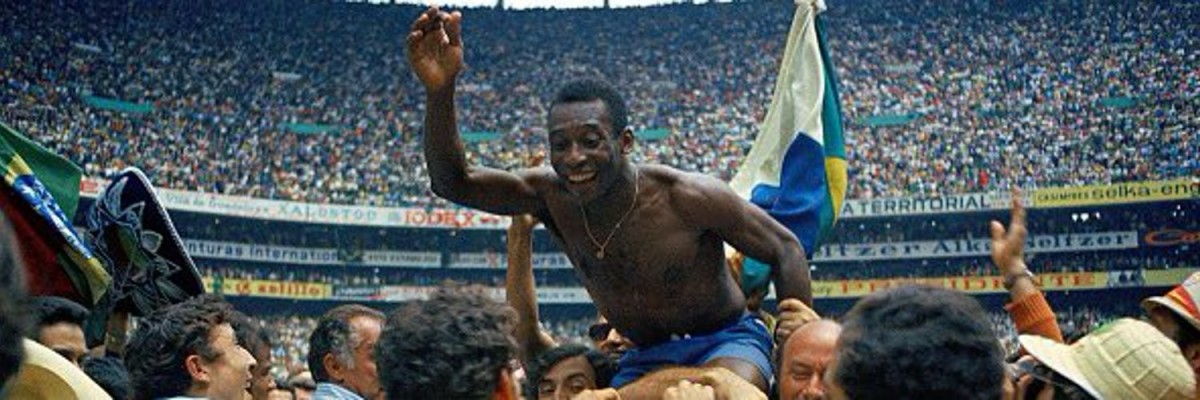
At the final whistle, Pelé was lifted onto the shoulders of his teammates—just as he had been 12 years earlier as a teenager in 1958. This time, he did not cry; instead, he found himself shirtless, embraced by history, leaving behind an immortal legacy.
With their third title, Brazil earned the Jules Rimet Trophy permanently, though it was later stolen in 1983 and never recovered.
Stars and Records
Jairzinho, the “Hurricane,” told French media:
“In 1970, we practically had 11 stars on the pitch. We were the only team in the world with five players who could all play as a number 10.”
Jairzinho became the only player in World Cup history to score in six consecutive matches in a single edition (7 goals) and win the title. Germany’s Gerd Müller finished as top scorer with 10 goals.
Surprises and Drama Beyond the Pitch
Qualifying brought major shocks: Argentina, France, Spain, and Hungary all failed to reach the finals. Europe’s allocation dropped from ten spots to nine, while Africa secured a guaranteed place—claimed by Morocco in its first-ever appearance. Israel represented Asia for the first and only time.
Tensions between Honduras and El Salvador escalated into the infamous “Football War,” which claimed 3,000 lives.
England’s preparations were disrupted when captain Bobby Moore was detained in Colombia for four days over an alleged jewelry theft. Though he was officially cleared two years later, the incident likely cost him a royal honor.
England exited in the quarterfinals despite leading 2–0 against West Germany, who avenged their 1966 final defeat with a 3–2 extra-time win.
The semifinals featured four former champions:
-
Brazil defeated Uruguay 3–1.
-
Italy edged West Germany 4–3 in a classic. Brazil then claimed the title with a commanding 4–1 victory in the final.