Report by Dr. Talal Osman
“Epic battle” awaits after nine‑goal Champions League thriller
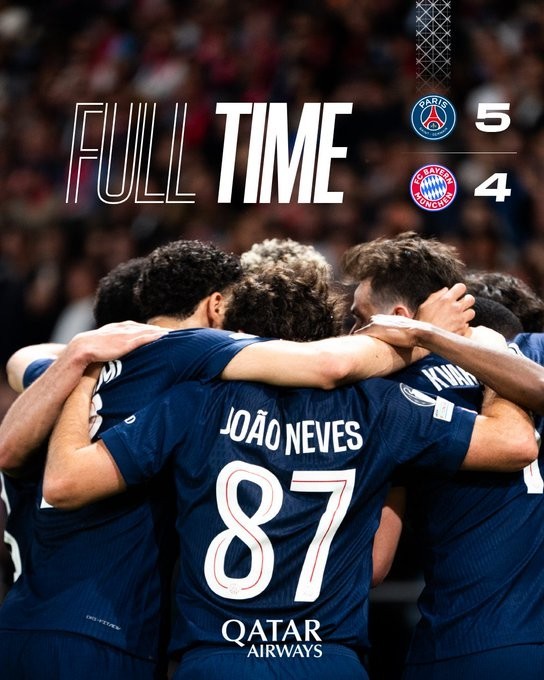
The nine goals in the first‑leg UEFA Champions League semi‑final, where Paris Saint‑Germain (the defending champions) beat visiting Bayern Munich 5–4 at the Parc des Princes, clearly signal that a legendary, even more brutal and thrilling confrontation is coming in the second leg next week.
A night of footballing history
The match in the French capital fulfilled almost every criterion of exciting, attractive football, and most major global newspapers described it as potentially the greatest game in Champions League history.
The British Guardian asked: “Have we ever seen a match like this in football? It was a bright, vivid, slightly crazy evening. Paris and Bayern gave us a show that felt like an entirely different category of human activity.”
French daily L’Équipe hailed it as evidence of “total football”—the all‑round style first popularized by the Dutch in the 1970s and carried forward by Barcelona under Johan Cruyff and later Pep Guardiola. Le Parisien called it a “magical match, simply”, while Le Monde described it as a “final before the final... and it lived up to all its promises.”
German and international perspectives
On the German side, the tabloid BILD wrote about the epic clash in which Bayern led 1–0, PSG then surged ahead 5–2, and the game ultimately ended 5–4: “We’ve never been enchanted to this extent, and we’ve never shaken our heads in admiration so much,” calling it the “greatest showcase match in Champions League history.”
Another German paper, Süddeutsche Zeitung, described the game as “an invention of football without limits,” while Die Welt saluted the players with: “No hesitating, no over‑coaching, just the pleasure of playing. Thanks for this huge, celebratory spectacle,” and the weekly sports magazine Kicker styled it a “breathtaking exchange of punches.”
Spanish daily Marca dubbed it a “special tribute to football in Paris,” and AS wrote on X (formerly Twitter): “A historic match... an epic clash with nine goals in 70 minutes.”
Portuguese newspaper A Bola argued the tie “deserves to be exhibited in a Louvre‑style museum dedicated to the world’s most popular sport,” while the New York Times called the Paris night “football at its highest level.”
Record‑breaking, goal‑crazy tie
The match in Paris set a new Champions League‑era record for the most goals in a single semi‑final leg and took the competition to a level not seen in this stage since the 1960 European Cup, when Eintracht Frankfurt beat Rangers 6–3 away before losing the final to Real Madrid 3–7.
Although PSG leave the first leg with a 5–4 advantage, they know that conceding four goals at home means they will face their toughest test next week when they travel to Bayern’s Allianz Arena in Munich—the stadium where Paris won their first Champions League title in the previous season.
Coaching reaction and the stakes ahead
Belgian coach Vincent Kompany, who watched the match from the stands because of a suspension, said of the return leg: “More… and even more excitement.” He added: “We’ll play at home with 75,000 fans in the stands. We don’t want only noise, we want a real roar. This stadium has never been short of special moments with this team.”
In his second season with Bayern, Kompany is overseeing a historically offensive‑minded campaign, as the Bavarians chase a treble. Bayern already clinched the Bundesliga title and set a new domestic scoring record with 113 goals with three matches remaining, surpassing the old mark of 101 goals from the 1971–1972 season.
For the first time in the club’s history, three Bayern players—Harry Kane, Michaël Olise, and Luis Díaz—have each reached double‑digit attacking contributions (goals plus assists) in a single Champions League season. Kane, England’s captain, scored in the first leg, taking his tally in the competition to 13, and leads the Bundesliga scoring charts with 33 goals. Bayern also await a DFB‑Pokal final against Stuttgart on 23 May.
Kompany underlined the tension loudly: “When you concede five goals in the Champions League you’re almost out, but we scored four in Paris, so we proved we can score; and we’ll do the same on our own ground. We know the second leg is at home and we must win; with our supporters behind us, the confidence is there.”
PSG’s vision for the return
Spanish coach Luis Enrique, who led PSG to a 5–0 triumph over Inter in last season’s final, their first Champions League title, expects even more fireworks in Munich. He told his staff: “How many goals do you think we need next week?” and said, “We all believe it will be another goal‑rich game, and perhaps we can score at least three goals there.”
He acknowledged the intensity of the first leg: “The intensity was extraordinary throughout. We’re very happy with the win, but after 5–2 we felt we could have finished with an even better score. We deserved the win, but we also could have deserved a draw or even a defeat.”
First‑leg script and the second‑leg scenario
The chaotic first half saw Bayern take an early penalty lead through Harry Kane, before Georgian Khvicha Kvaratskhelia and youngster João Neves put PSG ahead. Olise equalised 2–2, and Ousmane Dembélé restored PSG’s edge with another penalty before half‑time.
Kvaratskhelia and Dembélé struck again to make it 5–2, giving the impression PSG were about to seal the tie comfortably, only for French defender Dayot Upamecano and Colombian Luis Díaz to pull it back to 5–4, leaving the Munich showdown hanging on a razor‑thin margin.
With that scoreline, the second leg in Munich will be red‑hot, and there is a real chance this tie becomes the highest‑scoring two‑legged Champions League clash ever. The current record for combined goals in a two‑leg tie stands at 13, set by Inter’s 7–6 aggregate win over Barcelona in the previous season’s semi‑final.
The Paris 5–4 first‑leg result has already smashed the modern Champions League record for goals in a single semi‑final match—and now the world waits to see if the Munich return will turn the whole tie into the most explosive Champions League story of the 2025–2026 season.