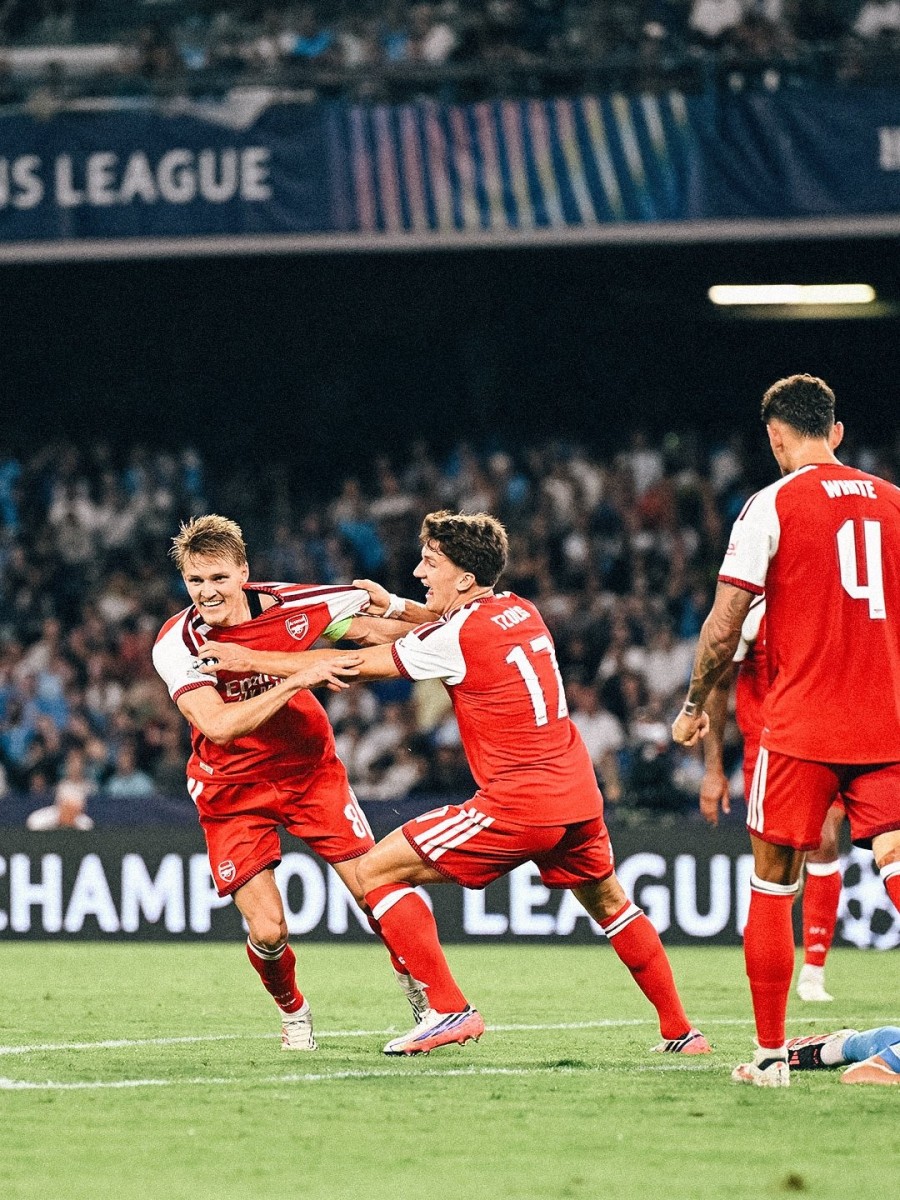
When Dominance Isn't Enough: Arsenal Beat Napoli by a Single Goal and Leave Maradona Asking About Fairness
UEFA Champions League 2026/27 — League Phase, Matchday 1 Napoli 0-1 Arsenal | Diego Armando Maradona Stadium, Naples Match Winner: Martin Ødegaard (75')
Some victories are measured by the scoreline. Others are measured by the gap between what actually happened and what should have happened. Arsenal's win over Napoli at the "Maradona" belongs firmly to the second category: a modest 1-0 scoreline concealing one of the most lopsided displays of dominance seen in a European competition this season and raising a question that goes beyond Arsenal alone, touching the very philosophy of modern football: at what point does overwhelming superiority stop being a guarantee and start becoming a psychological burden?
A Number That Doesn't Lie: 26 Shots, 4 "Expected" Goals — and Only One That Counted
The numbers here aren't statistical decoration; they are the story itself. Arsenal fired off 26 shots at the Napoli goal the most any side has recorded in a single Champions League match since the competition's restructuring in 2003. Their expected-goals tally (xG) stood at 4.05 against a mere 0.22 for Napoli a gap that reflects total containment rather than any real contest. In the first half alone, Arsenal managed 13 shots, the most by any away side in a Champions League first half in two decades, with Bukayo Saka alone responsible for five shots worth 0.95 xG.
But football, as we are reminded time and again, cannot be settled by equations alone. Piero Hincapié wasted a golden chance from six yards in the 50th minute, blazing a header over the bar in what amounted to a tactical crime. Noni Madueke's shot in the 85th minute was parried by the goalkeeper, and Christos Tzolis's follow-up was cleared off the line. This was not the performance of a team short on cutting edge — it was the performance of a team so awash in chances that it began to take them for granted. That, in itself, is a paradox worth sitting with: excess dominance becoming a reason to delay the kill rather than deliver it.
Ødegaard: From "Forgotten Man" to Maestro Who Decides Through Construction, Not Chance
The lone goal of the match was neither a gift nor a defensive error — it was the product of 29 consecutive passes in the build-up, the second-longest passing sequence to precede a goal in recorded Champions League history. That final pass, finished by Norwegian captain Martin Ødegaard with a precise low strike into the corner after a slick one-two with substitute Tzolis, distills Mikel Arteta's entire footballing philosophy: tactical patience as a weapon, not a flaw.
Ødegaard's individual numbers on the night were exceptional by any measure: leading chance creator (6 chances created), most touches on the pitch (120), and most line-breaking passes (5). But more significant than a single match's statistics is the broader arc: a player who scored just one goal in 36 games last season has now scored four in five games this campaign. This isn't a fleeting improvement in finishing — it reads more like the rediscovery of a player who was there all along, hidden behind a curtain of hesitation.
Allegri's Napoli: A Project Still Searching for Its European Identity
On the other side stands Napoli, at a crossroads familiar to every big Italian club that changes managers after a title-winning season. Massimiliano Allegri, who succeeded Antonio Conte this summer, found himself facing a top-tier European side without his own team able to impose any real attacking identity. Twenty-six shots for Arsenal against roughly five for Napoli sums up the scale of the gap Allegri must close if Napoli are to be more than polite guests on football's biggest stage. Kevin De Bruyne's decision in the 89th minute choosing to cross rather than shoot in Napoli's best chance of the match wasn't merely an individual error; it was a condensed image of a team thinking defensively even in its attacking moments.
Arteta: The Record as an Indictment, Not a Badge of Honor
Mikel Arteta's post-match comments stood out for their rare honesty: "The performance was superb, but it's a shame we missed so many big chances." A manager describing his own team's win as "a shame" is not false modesty it is an accurate reading of the fact that the gap between 1-0 and 4-0 in this match was not a matter of luck, but of execution.
The win extends Arsenal's winning run to five straight matches across all competitions and pushes their Champions League group-stage/league-phase winning streak to 13 consecutive matches the second-longest in the competition's history. In what was Arteta's 40th match in the competition, Arsenal recorded their 20th clean sheet four more than any rival manager since the 2023/24 season. These aren't passing statistics; they are a signature. Arteta's Arsenal is no longer just building a dangerous attacking side it first built a defensive wall solid enough to afford them the right to squander attacking chances without paying the full price for it. That is a luxury reserved only for clubs that have mastered balance before they ever think about dazzling.
A question still hangs in the Naples air: is it enough for a team to be four times better than its opponent across every statistical measure to convince itself it is on the right path? The answer, at least from Arteta's own vantage point, is that numbers — however impressive remain a means, not an end. And Arsenal, for all their superiority, left the "Maradona" with three points, not four goals which alone is enough to keep the warning light flashing in the club's tactical analysis room back in London.
Dr. Talal Othman, General Manager — GCC Sport