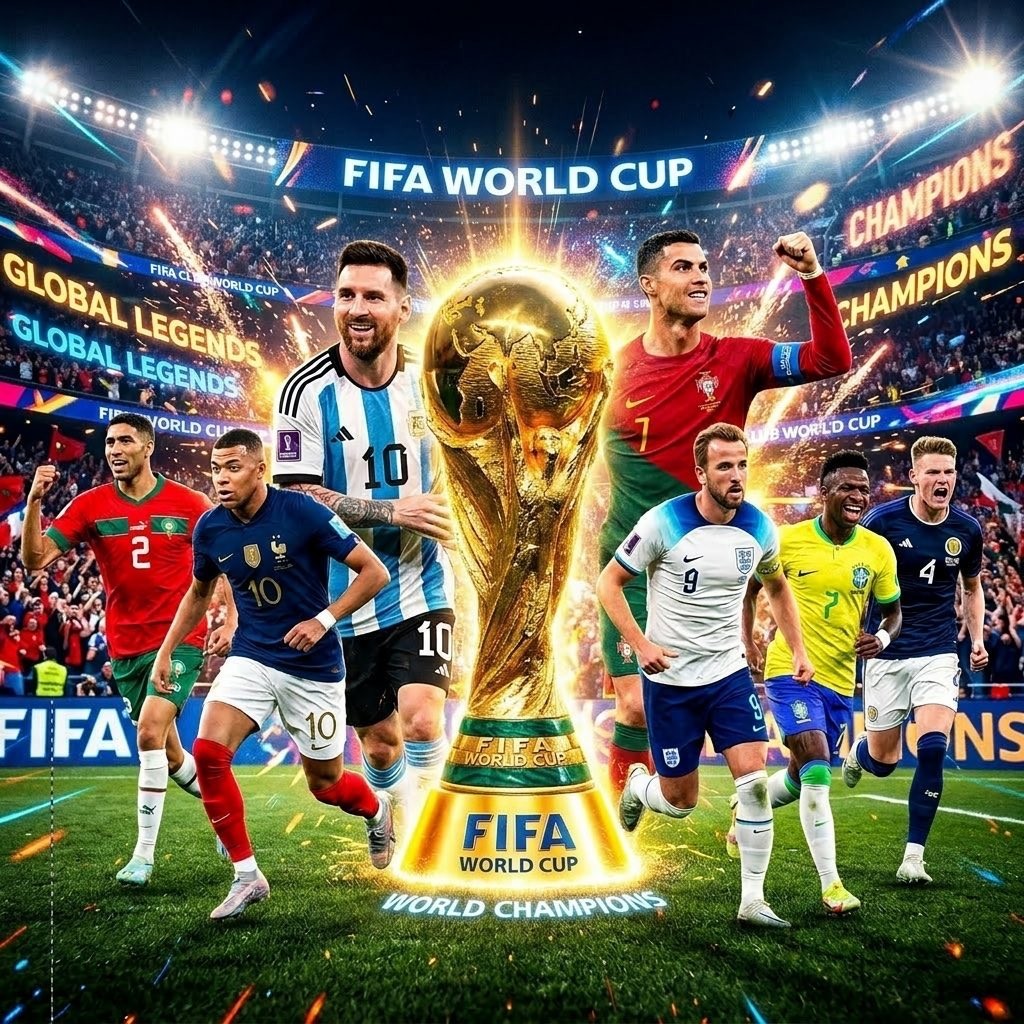
The World Cup may demand a complete team to lift the trophy, but the Golden Boot often belongs to the brilliance of a single player. As the world prepares for the 2026 FIFA World Cup, the race for the tournament’s top scorer emerges as one of the most intriguing storylines a battle shaped by talent, timing, and the fortunes of each national team.
History offers clues. Across past editions, the Golden Boot has rarely gone to veteran players. The average age of the winners hovers around 25 years old, with Croatia’s Davor Šuker standing out as a rare exception when he claimed the award at age 30 in 1998.
This trend complicates the chances of England’s Harry Kane, despite his exceptional scoring form heading into the tournament. Age also works against Lionel Messi, likely entering his final World Cup, and Cristiano Ronaldo, who dreams of one last historic achievement at 41.
On the opposite end of the spectrum stands a new wave of talent — led by Spain’s teenage sensation Lamine Yamal, who will turn 19 just days before the final. Beyond his extraordinary skill, Yamal benefits from a Spanish team that appears more mature and competitive than in recent editions.
But the decisive factor in the Golden Boot race remains the same: how far a player’s team advances. Early elimination means fewer matches and fewer scoring opportunities. This is why Cristiano Ronaldo lost the 2018 race despite a spectacular start, while Harry Kane secured the award thanks to England’s deep run to the semifinals.
There are exceptions none more famous than Russia’s Oleg Salenko, who scored five goals in a single match against Cameroon in 1994 and won the Golden Boot despite exiting in the group stage. A story that still feels surreal.
Among all contenders, Kylian Mbappé remains the most logical favorite. At 27, the French captain is in his prime, already owns a Golden Boot from 2022, and plays for a team with one of the strongest attacking units in the tournament. If France reaches the latter stages again, Mbappé could become the first player in history to win the award twice.
Norway’s Erling Haaland is not far behind. His extraordinary scoring consistency keeps him in the conversation, but his chances depend heavily on Norway’s ability to survive the early rounds — something far from guaranteed.
Brazil enters the tournament with attacking firepower in Vinícius Júnior, Raphinha, and Igor Thiago, yet the team’s inconsistent form during qualifiers raises questions about whether any of their forwards can match the output of France, Argentina, or Spain.
Argentina, meanwhile, boasts multiple threats in Lautaro Martínez and Julián Álvarez, both capable of emerging as top scorers depending on the team’s tactical approach.
And as history has shown, the Golden Boot does not always go to the “best striker in the world,” but rather to the player who combines individual sharpness, team strength, and perfect timing.
Between Mbappé, Kane, Haaland, Yamal, Messi, and perhaps an unexpected name, the 2026 World Cup may deliver a new chapter in one of football’s most unpredictable individual awards.