
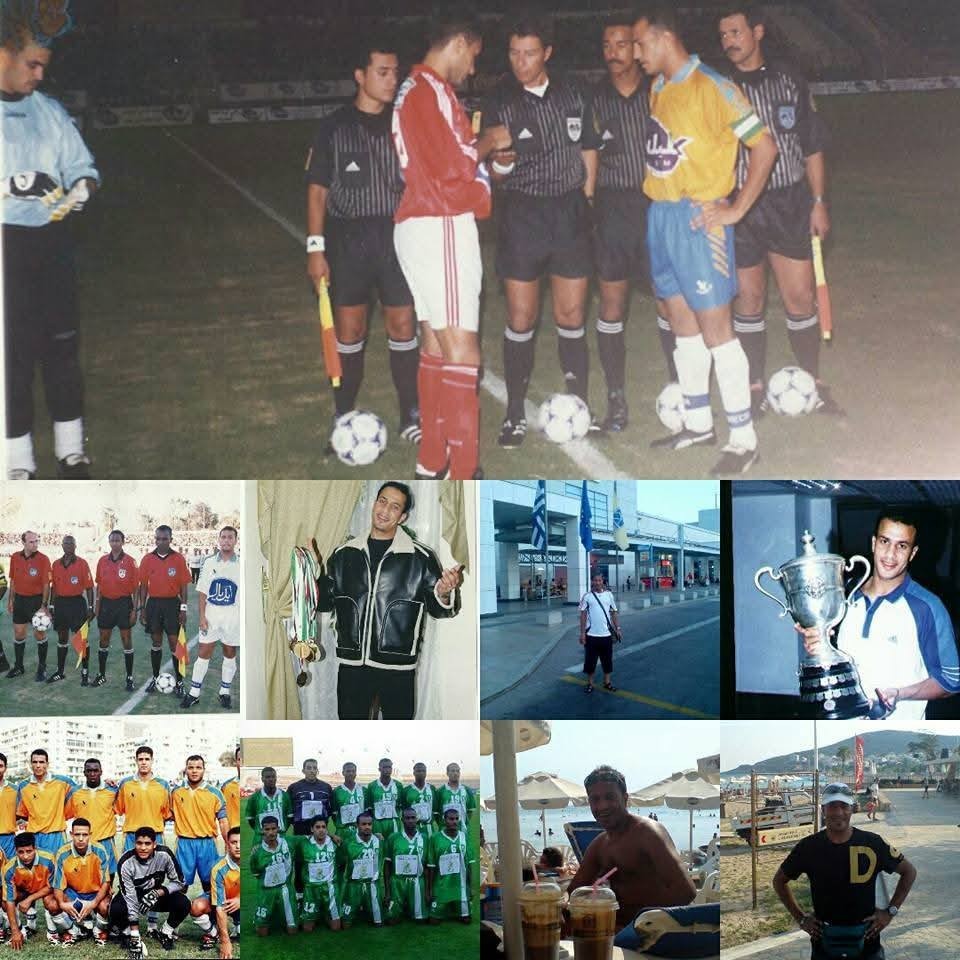
Interview by Dr. Talal Osman
Captain Reda Sikka: The Uncompromising Warrior of Egyptian Football
Captain Reda Sikka—tough, solid, and a personality unlike any other in Egyptian and Arab football—accepted our invitation to share his story, insights, and vision for the future of the game.
Our site is honored to host one of the most iconic defensive figures in Egyptian football: a star that no fan forgets and no history book can overlook.
Captain Reda Sikka, born in Ismailia, the rock of Zamalek, and a warrior for the Egyptian national team, a man of difficult moments who never retreats and never bargains on the honor of the jersey.
Reda Sikka is not just a player who passed through the stadiums; he is a solid football character who carved out his place among the elite through the strength of his performance, the courage of his spirit, and the sincerity of his loyalty. A fierce competitor on the pitch, a respectful professional off it, and a player with a rich career spanning Egypt and Saudi Arabia, making him today one of the most experienced figures in understanding the hidden dynamics of Arab football.
Thanks to his long‑standing experience, wide network of contacts, and clear football vision, Captain Reda Sikka now serves as the sports content manager for our site, guiding the editorial direction with the experience of a player, the intelligence of an analyst, and the depth of a man who lived football from the inside.
He is a clear and honest voice… a transparent view… and a career that cannot be bought.
He is the player who never bends… the defender no one can pass through… and the man who adds value to any environment he joins.
Captain Reda Sikka… a name that needs no introduction. A rock in the defense of Ismailia, Zamalek, and Egypt, a fierce player who forged his place among the greats of Egyptian football. Today he puts his vast experience and wide connections at the service of our platform as its sporting content manager, steering the editorial line with the mindset of a seasoned player and the personality of a tough man who knows only the truth.
When you talk about strength… you mention Reda Sikka.
When you talk about manhood… you mention Reda Sikka.
And when you search for a player who does not fear, does not retreat, and does not compromise… his name will always appear.
He is one of the last of the “men defenders” in Egyptian football.
He is the player whom opponents respected before the fans.
And today he places all this experience in your hands as our site’s sporting manager, steering the content with the soul of a fighter and the mind of a specialist.
How did your journey with football begin, and who first discovered your talent?
“My start came from Tel El‑Kebir in Ismailia… that’s where I grew up and first dreamed of football. My real first step was in the youth sector, and in the 1988 season I played a braces match for my team against Ismaily.
That match in particular… I felt my life was going to change. My performance caught attention, and from there began my real journey, the moment they discovered my talent and my path with the Dragons started.”
The qualities that shaped Reda Sikka’s personality on and off the pitch
“My personality was built on two things: discipline and manhood.
On the field, I always believed that a defender must be solid, unafraid of contact, and unshaken by any pressure. I used to play with high intensity, feeling that every ball was a battle that I had to win.
Off the field, the situation is different. By nature I am calm, and I like to deal with people with respect. That’s perhaps why my personality was seen as strong without being confrontational. I learned that a player must be a role model, and that your self‑respect is what makes others respect you.”
What does Al Ismaily mean to you personally and professionally?
“Al Ismaily for me is not just a club… it’s a home.
It’s the place that raised me, the club that built my name, and the one that taught me what it means to play with dignity and carry the name of an entire city on your back.
It was Al Ismaily that introduced Reda Sikka to the world, and it was Ismaily that made me believe a player is not just ability—a player is soul, and the Dragons are the school of soul.”
Memorable moment with the Dragons
“My best moments were the first time I heard Ismaily fans chanting my name… that moment never fades.
Also, our big league matches, especially when we played against the top clubs and proved that Ismaily always has its place and its prestige.
There are many moments carved in my mind, but the first time I put on the yellow shirt… that was a lifetime moment.”
Can Al Ismaily return to the podium, and what is required?
“Yes, of course they can. Al Ismaily is a big club, and its history is bigger than any crisis.
But the return needs three things:
Real administrative stability—without that, no team can stand on its feet.
A clear football project—built on youth, and players with the soul of Al Ismaily.
Al Ismaily fans—when the fans stand, the team stands.
Al Ismaily is not far from the trophies… it just needs to return to its identity.”
Your experience with Zamalek and what makes this club different
“My time at Zamalek was a very important stage in my life. A big club, a huge fanbase, high pressure, and a player who must be equal to the occasion.
What distinguishes Zamalek is that you play for a club with a strong identity… a club of titles, and a crowd that does not accept anything less than a real man on the pitch.
Zamalek added a lot to me, let me play in big matches, and made me feel that every minute on the field must be at the highest level.”
Do you feel you gave everything with Zamalek, or could you have given more?
“By nature, whenever I enter the pitch I give everything I have, and that’s what I did at Zamalek.
But frankly… any player always feels he could have done more.
The circumstances sometimes help, sometimes they don’t, but I am satisfied with the period I spent there. I offered strength, commitment, and the fans remember that well.”
Your experience in the Saudi league, and how you would describe playing with Al Ahli
“My time in the Saudi league was one of the most important stages of my life. A strong league, a passionate fanbase, and ambitious clubs.
As for Al Ahli, it is a different club altogether. Big, well‑organized, and with a fanbase that carries a special prestige.
When I played for Al Ahli, I felt the responsibility was doubled. Every match had to be at the highest level.
The Saudi league was in a rising phase at the time, and I was part of that journey, and that is something I am proud of.”
The difference between the Arab player of the 1990s and the present‑day player in Saudi Arabia
“The Arab player of the 1990s relied on spirit, manhood, and hard work. There were not the same resources, and professionalism was not as advanced, but the personality was strong.
The current player in Saudi Arabia is different. He has resources, facilities, nutrition, world‑class coaches, and top‑level stadiums.
But despite all that, it is the spirit that existed back then that still makes the difference.
The current generation is very talented, but it needs to preserve the character of the Arab player who never fears the challenge.”
Do you think the Saudi league today has become one of the strongest in the region, and what is your view on its rapid development?
“The Saudi league nowadays is not only the strongest in the region—it’s one of the strongest leagues in Asia, and it’s moving steadily to become among the best in the world.
This development is not accidental; it comes from:
– Massive investment.
– World‑class players.
– Top coaches.
– Professional infrastructure.
– Fans creating a European‑style atmosphere.The Saudi league has become a dream destination for any Arab or foreign player, and I am proud that I was part of the early stages of this progress.”
Reda Sikka’s view of the current Egyptian national team under Hossam Hassan
“Frankly, the Egyptian national team under Hossam Hassan is moving in a clear direction: the return of the spirit comes first.
Hossam is the type of coach who, once he takes over a team, he changes the mentality before changing the formation… and that’s exactly what the national team needs right now.
I see that the team has begun to regain courage; we’re seeing players who play with manhood, pressure, and fight… and that is Hossam’s hallmark.
The team is still in a building phase; there is still a lot of work ahead. But the most important thing is that an identity has started to return.
Hossam doesn’t pamper players, and that is very important for the national team.
The player who is not ready… does not play.
The player who lacks spirit… does not stay.I am optimistic because under Hossam the national team is returning to relying on character before reputation, and on spirit before stardom.
And if this commitment continues, with a bit of patience, the team will stand on its feet again.”
Who is the best Arab player today?
“If we speak honestly… the best Arab player today is Mohamed Salah.
Not because he is the most famous, but because he has maintained his level for many years at the highest level in the world.
Salah did what no one else has done:
– Consistency.
– Numbers.
– Impact.
– Professionalism.
– Character inside and outside the pitch.There are excellent Arab players, but Salah has stayed at the top, and that is the hardest thing in football.”
Do you advise Mohamed Salah to play in Saudi Arabia?
“Yes, I advise him.
Why? Because the Saudi league today is not a step back; on the contrary, it is a strong step forward.
The Saudi league has become a global league:
– Big stars.
– Well‑organized clubs.
– Massive fanbases.
– Unprecedented investment.
– Top‑level coaches.If Salah comes to Saudi Arabia, he will be a technical and marketing asset for any club, and will receive huge respect and appreciation. At the same time, he will help raise the league’s level even more.
But the decision ultimately must be based on:
– The club’s project.
– His role in the team.
– His personal ambitions.
– The timing of the move.If the project fits him, Saudi Arabia can be a great stage for Salah.”
Who will win the league this season?
“This season’s league is not decided yet… and that’s its beauty.
You have three clubs standing on one foot:
Zamalek – Pyramids – Al Ahly.Each has a different strength:
? Zamalek
Has been playing with very high spirit, and that is what keeps them very much in the picture. If they maintain the stability they currently have, they will be fierce contenders until the last moment.? Pyramids
Are the most consistent team in performance, and that is very important in a league race. They have a strong squad and they win the matches they are supposed to win.? Al Ahly
Even if they fall behind, they never truly leave the race. They have experience, the personality of a champion, and the ability to come back in the very moment people think they’ve collapsed.? Who is closest?
Honestly, the title will go to the team that can handle the pressure in the last six matches.Not to the strongest team… to the most steady one.
If you ask me about my technical opinion:
Zamalek and Pyramids are the most stable, while Al Ahly is the most experienced.And the league will be decided on very small details…
But God willing, Zamalek will win.”
If Zamalek wins the league and the African Confederation Cup this season, it would be a real football miracle
“Why?
Because Zamalek has been through conditions no big club should bear:
– Financial problems.
– Star departures.
– Fan pressure.
– Administrative changes.
– Years of instability.And yet, the only club currently representing Egypt in Africa is Zamalek.
Al Ahly is out, Pyramids is out, and Zamalek—despite all the circumstances—goes on and carries the head of Egyptian football.
And this is no accident: it’s because Zamalek has spirit, fans, a local coach who understands the value of the shirt, and a squad of men who feel they are playing for a big club.
If Zamalek carries on with the same spirit, maintains focus, and stands firm in those last five–six matches… then, God willing, the league and the Confederation Cup are within reach.
And Zamalek deserves it… because they have suffered, were wronged, and were targeted… yet they are still standing.”
Interview conducted by Dr. Talal Osman


