When the Star Becomes the Owner: Cristiano Ronaldo's Final Reckoning with Football
By Dr. Talal Othman
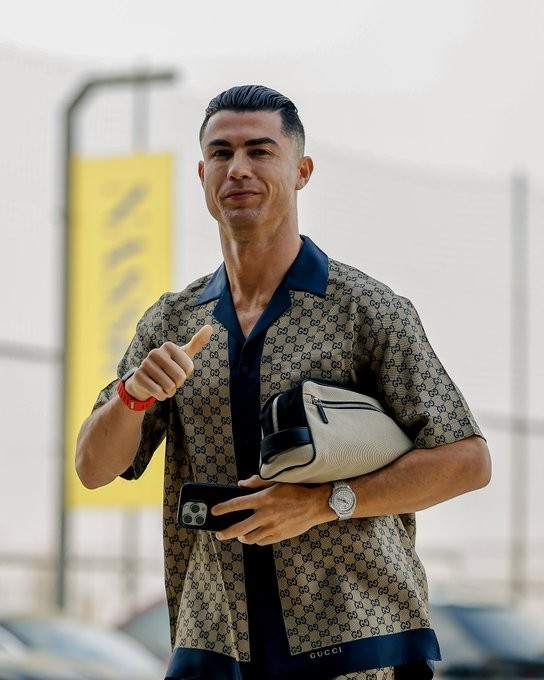
In the stands of a modest stadium in Portugal, in early August, a 41-year-old man sat beside the president of a Spanish football club, watching a friendly that meant little in the fixture list but everything in reading the picture slowly taking shape around his future. In that moment, Cristiano Ronaldo was not the familiar star of the pitch, but a spectator wearing another team's shirt a team he does not captain but in which he holds a stake approaching a quarter of its ownership. When Almería posted his photo in that shirt, they chose a telling caption: "One of us." A simple phrase, yet it captures a long unfolding shift in the relationship between one of the greatest players in the game's history and the sport itself from a man measured by goals, to a man increasingly measured by shares.
This is how serious sports journalism likes to tell the story of great endings: not as a sudden announcement at a press conference, but as an accumulation of small signals that, taken together, draw a clear map of what is coming. And the signals Ronaldo has been gathering these days need little interpretation.
An Admission No Longer Hedged
Ronaldo has long avoided speaking about the end of his career in definitive terms, preferring formulations like "as long as I feel happy" and "as long as my body responds." But his latest remarks broke that pattern. When a player of his stature says the current season will "most likely" be his last, the sentence should not be read as one possibility among many, but as an unofficial announcement paving the way for an official one. It is the language of a man who has begun writing the ending himself, word by word, rather than having it imposed on him.
Notably, this admission did not come in a vacuum. It arrived alongside a rising wave of investment activity that gives the next chapter of Ronaldo's life a clear shape: retirement, for him, will not be a leap into the unknown, but a calculated move into another position within the same industry.
Almería: More Than Just an Investment
When Ronaldo, through his company CR7 Sports Investments, acquired a 25% stake in Almería this past February, many framed the deal as a passing commercial move within a diversified investment portfolio. But the months since have revealed something deeper. Javier Tebas, president of Spain's La Liga, spoke of a roughly 25% rise in Almería's social media following after Ronaldo became a shareholder — a figure that reflects not fleeting media noise but genuine commercial value already showing up in the club's numbers.
Here lies a paradox worth sitting with: Ronaldo, who spent two and a half decades building his market value as a player, is now transferring part of that value to an entire football institution without having scored a single goal for it. It is a different model from that of past stars who, after retiring, settled for honorary or advisory roles. Ronaldo is already building, right now, an active executive position.
From Captain on the Pitch to a Voice Behind the Scenes
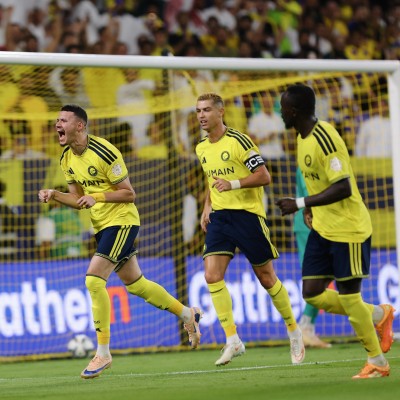
The image of Ronaldo in the stands, beside Almería president Mohamed El Khereiji, carries a symbolism hard to ignore. He remains, at the same time, captain and face of Saudi club Al-Nassr, the team he led into his Asian adventure after leaving Europe. Yet his presence in that moment as an "investor" rather than a "rival player" reveals that the boundaries of his sporting identity have widened to encompass more than one shirt, and more than one role.
This is precisely what Spain's Cadena SER is gesturing toward in its report: that Almería a mid-sized club on the map of Spanish football may gradually become the central project of Ronaldo's post-retirement life. Not because it is the biggest or most glamorous, but because it sits closest to the decision-maker's heart, and is the most malleable to his vision.
A Legacy Written Twice
Ronaldo always says he wants to end his career with a great legacy. But the legacy he is building now is dual: one of numbers and titles, nearing its final chapter; and another, quieter and less immediately dazzling, taking shape far from the lights of the biggest stadiums in boardrooms, investment decisions, and sponsorship files.
This path may not deliver the same headlines he has grown used to for two decades, but it may offer him something he perhaps values more with age: continuity of presence in the game that shaped his life, without needing to lace up boots to prove it. And if football has learned anything from Cristiano Ronaldo over twenty-five years, it is that he rarely lets a chapter close without writing its final line himself.